The Guide to OpenBao - Introduction - Part 1
February 11, 2026
-
 Thomas Jungbauer
-
7 min read
(1496 words)
Thomas Jungbauer
-
7 min read
(1496 words)

I finally had some time to dig into Secret Management. For my demo environments, SealedSecrets is usually enough to quickly test something. But if you want to deploy a real application with Secret Management, you need to think of a more permanent solution.
This article is the first of a series of articles about OpenBao, a HashiCorp Vault fork. Today, we will explore what OpenBao is, why it was created, and when you should consider using it for your secret management needs. If you are familiar with HashiCorp Vault, you will find many similarities, but also some important differences that we will discuss.
Introduction
In general, sensitive information in any system should be stored in a secure way. When it comes to OpenShift or Kubernetes, this is especially true, since the secrets are stored in the etcd database. Even if etcd is encrypted at rest, anybody can decode a given base64 string which is stored in the Secret.
| Base64 is not an encryption format. It is an encoding format. |
For example, the string Thomas encoded as base64 is VGhvbWFzCg==. This is simply masked plain text and it is not secure to share these values, especially not on Git. To make your CI/CD pipelines or GitOps process secure, you need to think of a secure way to manage your Secrets.
This is where OpenBao comes in.
What is OpenBao?
OpenBao is an identity-based secrets and encryption management system. It is an open-source, community driven fork of HashiCorp Vault and provides secure storage, fine-grained access control, and lifecycle management for secrets such as API or SSH keys, passwords, certificates, and encryption keys.
The core OpenBao workflow consists of four stages:
Authentication: Verifying the identity of the client to determine if they are who they say they are. Once authenticated, a token is created and associated with a so-called policy.
Validation: Checking if the client has the required permissions
Authorization: Granting access based on policies that provide or deny access to certain paths and operations in OpenBao.
Access: Limiting what the client can do with the secret
At its core, OpenBao:
Stores and encrypts sensitive information at rest and in transit
Provides fine-grained access controls (ACL)
Supports dynamic secret generation
Offers a comprehensive audit trail (must be enabled)
Enables encryption as a service
The History: Why OpenBao Exists
OpenBao is a community-driven, open-source fork of HashiCorp Vault. But why was it created?
In August 2023, HashiCorp announced a significant change to the licensing of their products, including Vault. They moved from the Mozilla Public License 2.0 (MPL 2.0) to the Business Source License 1.1 (BSL 1.1).
The BSL 1.1 license includes restrictions on competitive use:
Competitors could no longer use Vault’s code to offer competing services
Cloud providers and managed service providers faced restrictions
The open-source community lost the freedom to fork and commercialize
The Fork
In response to this license change, the Linux Foundation announced the OpenBao project in December 2023. OpenBao is:
A fork of HashiCorp Vault (from version 1.14.x)
Licensed under the OSI-approved Mozilla Public License 2.0
Governed by a community-driven model
Maintained independently of HashiCorp
Continues to enable innovation without license restrictions
OpenBao vs. HashiCorp Vault: Key Differences
While OpenBao shares its heritage with Vault, there are several important differences:
Licensing
| Aspect | OpenBao | HashiCorp Vault |
|---|---|---|
License | MPL 2.0 (OSI-approved open source) | BSL 1.1 (with staged conversion) |
Governance | Community-driven (Linux Foundation) | HashiCorp/IBM controlled |
Commercial restrictions | None | Restrictions on competitive use |
Enterprise Features | Community-driven additions | Paid Enterprise tier |
Support | Community support | Paid support available |
Branding | bao CLI, OpenBao naming | vault CLI, Vault naming |
Technical Differences
Token Format - OpenBao uses shorter tokens in the format
sbr.[random], while Vault uses longer tokens (hvs.,hvb.,hvr.prefixes followed by long random strings). Old Vault tokens are still accepted according to their TTLs, but newly issued tokens follow the OpenBao format.Plugin Ecosystem - OpenBao comes with fewer built-in plugins by default, focusing on OSI-licensed integrations. Proprietary cloud vendor plugins have been moved to external repositories.
Storage Backend - OpenBao has simplified its storage options, primarily supporting Raft as the recommended backend.
API Compatibility - OpenBao’s API is designed to be compatible with Vault, meaning existing clients and integrations should work without modification. However, some edge cases may require updates.
Core Concepts
Before diving into installation and configuration in the next articles, it is essential to understand the fundamental concepts of OpenBao:
Secrets Engines
Secrets engines are components that store, generate, or encrypt data. OpenBao supports multiple types:
KV (Key-Value): Simple static secret storage with optional versioning
PKI: Certificate Authority for generating TLS certificates
Database: Dynamic credential generation for databases
Transit: Encryption as a Service (EaaS)
SSH: SSH key signing and OTP generation
Authentication Methods
Authentication methods verify client identity before granting access:
Kubernetes: Uses Kubernetes service account tokens. Essential for Kubernetes/OpenShift deployments.
OIDC: OpenID Connect for user authentication, like Keycloak, Okta, or Azure AD.
LDAP: Directory service authentication, like Active Directory, OpenLDAP, or Microsoft AD.
AppRole: Machine-oriented authentication for applications. Ideal for CI/CD pipelines.
Token: Direct token-based authentication. The root token is created during initialization.
Storage Backend
OpenBao encrypts all data before writing to storage. Supported backends include:
Integrated Raft (recommended): Built-in distributed storage
Consul: HashiCorp’s service discovery and KV store (less common with OpenBao)
File: Single-node deployments only
PostgreSQL/MySQL: Database-backed storage
Policies
Policies define what a client can do after authentication. They use path-based access control (deny-by-default mode):
path "secret/data/myapp/*" {
  capabilities = ["read", "list"]
}

path "pki/issue/my-role" {
  capabilities = ["create", "update"]
}

path "database/creds/myapp-role" {
  capabilities = ["read"]
}
Tokens
Tokens are the primary authentication credential in OpenBao. After successful authentication, clients receive a token that:
Has a TTL (Time To Live)
Is associated with one or more policies
Can be renewed (if renewable)
Can create child tokens
Seal/Unseal
OpenBao starts in a sealed state where it cannot access encrypted data. The unseal process requires multiple key shares (using Shamir’s Secret Sharing) or auto-unseal mechanisms to decrypt the master key.
Leases
Most secrets in OpenBao have an associated lease - a duration after which the secret expires. This enables:
Automatic secret rotation
Revocation of compromised credentials
Audit trail of secret usage
Use Cases
Dynamic Database Credentials
Instead of storing static database passwords:
Application authenticates to OpenBao
Requests database credentials
OpenBao creates a temporary database user
Returns credentials with a short TTL
Credentials automatically expire
Benefits: No long-lived credentials, automatic rotation, per-application isolation.
Certificate Management with PKI
Instead of manually managing TLS certificates:
Configure OpenBao as an intermediate CA
Applications request certificates on demand
Short-lived certificates (hours/days instead of years)
Automatic renewal before expiration
Benefits: No certificate sprawl, automated rotation, reduced attack surface.
Encryption as a Service
Instead of implementing encryption in each application:
Applications send plaintext to OpenBao’s Transit engine
OpenBao encrypts with managed keys
Applications store ciphertext
Decryption requests go through OpenBao
Benefits: Centralized key management, separation of duties, key rotation without re-encryption.
Kubernetes Secret Injection
Instead of storing secrets in Kubernetes Secrets:
Deploy OpenBao with Kubernetes auth
Configure injector or External Secrets Operator
Pods automatically receive secrets at startup
Secrets never stored in etcd
Benefits: Secrets not in cluster, dynamic injection, centralized management.
When to Use OpenBao
OpenBao is an excellent choice when you need:
Centralized Secret Management - If you have secrets scattered across configuration files, environment variables, and various secret stores, OpenBao provides a single source of truth.
Dynamic Secrets - For use cases where you need short-lived, automatically rotated credentials (e.g., database passwords), OpenBao can generate them on-demand.
Encryption as a Service - If applications need encryption capabilities without managing encryption keys, OpenBao’s Transit engine provides this functionality.
Certificate Management - OpenBao’s PKI engine can act as a Certificate Authority, issuing and managing TLS certificates.
Compliance Requirements - For environments with strict audit requirements, OpenBao provides comprehensive audit logging of all secret access.
When NOT to Use OpenBao
OpenBao might be overkill for:
Simple, Static Secrets - If you only have a few static secrets that rarely change, simpler solutions like Sealed Secrets or External Secrets Operator with a basic backend might suffice.
Small Teams with Limited Resources - OpenBao requires operational expertise to maintain. If you do not have the resources to operate it properly, consider managed alternatives.
Single-Application Deployments - If you have a single application with minimal secret requirements, the complexity of OpenBao may not be justified.
Architecture Overview
A typical OpenBao deployment consists of:
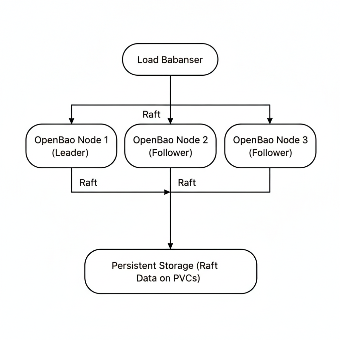
Multiple Nodes: For high availability (HA), OpenBao runs as a cluster
Raft Consensus: Leader election and data replication
Persistent Storage: Encrypted data stored on persistent volumes
Load Balancer: Distributes client requests
Conclusion
OpenBao provides a powerful, open-source solution for secret management that addresses the challenges of modern cloud-native environments. Its fork from HashiCorp Vault means it benefits from years of development while remaining truly open source.
In the next article, we will start with a standalone installation to understand the fundamentals before moving to Kubernetes deployments.
Resources
Related Articles


Copyright © 2020 - 2026 Toni Schmidbauer & Thomas Jungbauer
Discussion
Comments are powered by GitHub Discussions. To participate, you'll need a GitHub account.
By loading comments, you agree to GitHub's Privacy Policy. Your data is processed by GitHub, not by this website.